

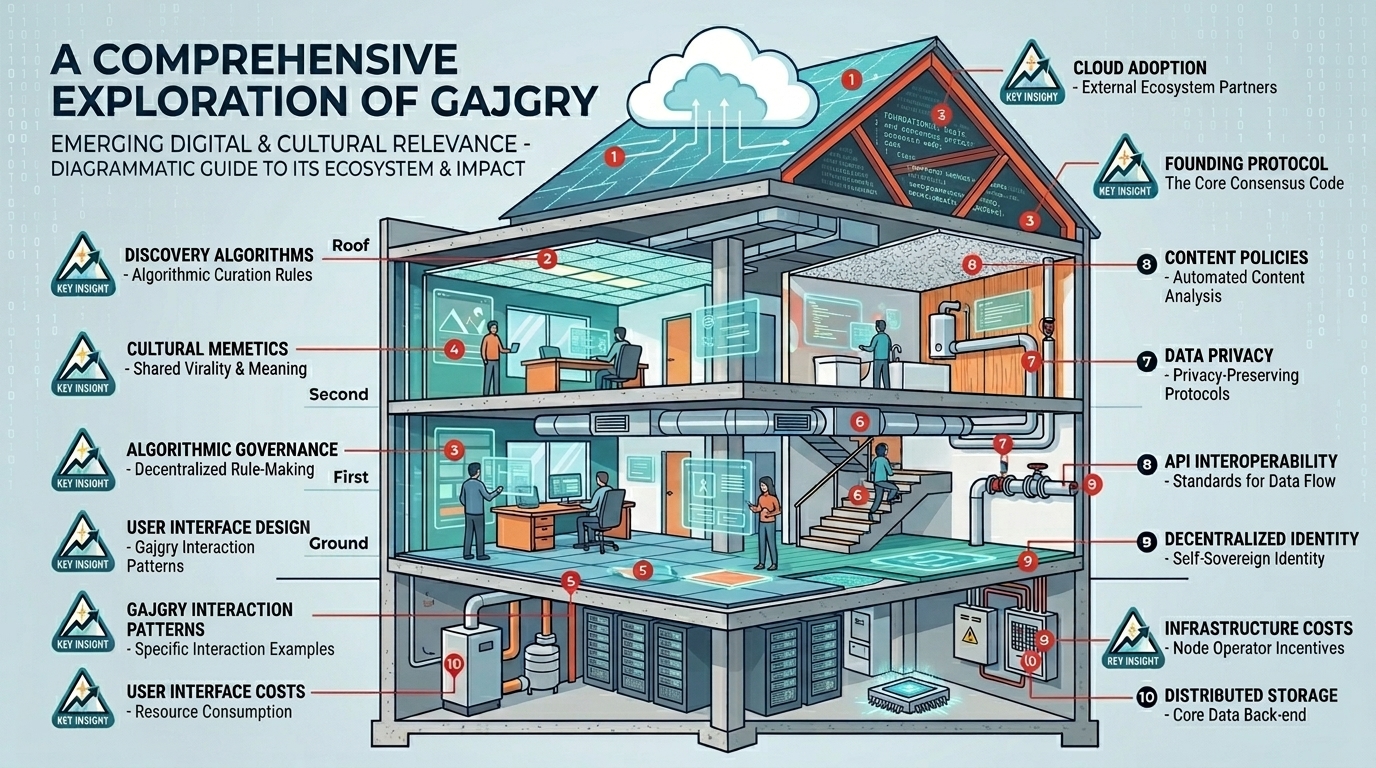
Gajgry is increasingly used as a conceptual keyword representing structured innovation in digital ecosystems, symbolic data interpretation, and adaptive system design. Although the term appears abstract, its application has evolved into a framework for understanding how modern technologies organize, process, and refine complex information across different industries. In contemporary digital environments, gajgry serves as a symbolic reference point for emerging systems that rely on layered intelligence, flexible architecture, and interconnected operational models.
As organizations continue to expand their digital infrastructure, the importance of adaptable frameworks becomes more significant. Within this context, gajgry is often associated with systems that prioritize responsiveness, efficiency, and scalability while maintaining interpretive depth in both technical and conceptual environments.
The Conceptual Foundation of Gajgry in Digital Systems
The foundation of gajgry lies in the idea of structured abstraction, where complex systems are broken into manageable layers of functionality. This approach allows developers and analysts to interpret large datasets or operational models in a more efficient and meaningful way.
At its core, gajgry represents a fusion of logic-based structuring and adaptive interpretation, making it relevant in fields such as artificial intelligence, data analytics, and software architecture. The conceptual model supports dynamic adjustment, meaning systems can evolve based on input variations without losing structural integrity.
| Structural Layer | Function in Gajgry | Digital Equivalent |
|---|---|---|
| Core Layer | Base logic processing | Backend systems |
| Interaction Layer | User/system interface | UI/UX systems |
| Adaptive Layer | Learning and adjustment | AI and machine learning |
| Output Layer | Final data presentation | Reports and dashboards |
This layered interpretation helps explain how gajgry functions as a multi-dimensional framework rather than a single operational tool.
Evolution of Gajgry in Technological Development
The evolution of gajgry can be understood through the broader timeline of digital transformation. Early computing systems relied on rigid structures with limited flexibility, but modern systems demand adaptability and contextual awareness. This shift has contributed to the conceptual rise of gajgry, where systems are no longer static but continuously evolving based on user interaction and environmental data.
In modern development environments, gajgry is often linked with modular design principles that allow systems to be updated without disrupting core operations. This evolution reflects the growing need for efficiency in cloud computing, distributed networks, and real-time processing systems.
The transformation of digital architecture demonstrates how gajgry aligns with current technological demands, especially in environments where scalability and responsiveness are critical for success.
Gajgry in Artificial Intelligence Systems
Artificial intelligence plays a central role in the practical interpretation of gajgry. AI systems depend on structured learning processes that continuously refine outputs based on input data. This aligns closely with the adaptive nature of gajgry, where systems evolve through iterative learning cycles.
Machine learning models, in particular, reflect the layered structure associated with gajgry, where data is processed, analyzed, and refined through multiple stages before reaching a final decision or output. This structured progression ensures accuracy and reduces operational errors.
| AI Component | Role in Gajgry Framework | Function |
| Data Input | Initial information stage | Collection |
| Processing Engine | Analytical transformation | Computation |
| Learning Model | Adaptive improvement | Pattern recognition |
| Output System | Final decision generation | Prediction |
Through this lens, gajgry becomes a symbolic representation of how artificial intelligence systems evolve and optimize themselves over time.
Gajgry and Data Management Systems
Data management is another area where gajgry demonstrates significant conceptual relevance. Modern organizations handle vast amounts of structured and unstructured data, requiring systems that can organize, filter, and interpret information efficiently.
Within this context, gajgry represents a methodology for optimizing data flow between storage systems and analytical engines. It emphasizes clarity, segmentation, and structured access, allowing organizations to retrieve meaningful insights without unnecessary complexity.
This approach is particularly useful in industries such as finance, healthcare, and logistics, where accurate data interpretation is essential for decision-making processes. By applying gajgry principles, organizations can improve both speed and reliability in their data operations.
Gajgry in Communication and Digital Interaction
Communication systems have also been influenced by the conceptual framework of gajgry. In digital communication, information must be transmitted clearly, efficiently, and without distortion. The structured nature of gajgry supports this requirement by emphasizing organized data flow and contextual clarity.
In social platforms, messaging systems, and collaborative tools, gajgry can be seen in the way information is filtered, prioritized, and displayed to users. Algorithms that determine content relevance or message prioritization often follow principles similar to those found in gajgry models.
The increasing demand for real-time communication further highlights the importance of such structured systems, where responsiveness and clarity are essential for user engagement.
Gajgry in Software Architecture Design
Software architecture benefits significantly from the principles associated with gajgry, particularly in modular and microservices-based environments. These architectures rely on independent components that work together to form a unified system, reflecting the layered structure inherent in gajgry.
Developers use this approach to ensure that applications remain scalable and maintainable even as complexity increases. Each module functions independently while contributing to the overall system behavior, creating a balanced and efficient operational model.
This design philosophy aligns with modern software engineering practices, where flexibility and adaptability are prioritized over rigid structural dependency.
Comparative Analysis of Gajgry-Based Systems
A comparative understanding of gaj-gry can be developed by examining traditional versus modern system designs. Traditional systems often rely on monolithic structures, while modern interpretations emphasize distributed and adaptive frameworks.
| System Type | Structural Design | Flexibility | Scalability |
| Traditional Systems | Monolithic | Low | Limited |
| Transitional Systems | Semi-modular | Medium | Moderate |
| Gajgry-Based Systems | Fully adaptive | High | Extensive |
This comparison highlights how gaj-gry aligns more closely with modern technological requirements, especially in environments that demand continuous evolution and adaptability.
Gajgry in Digital Innovation and Future Technologies
The future of digital innovation is closely tied to frameworks like gaj-gry, which emphasize adaptability and structured intelligence. Emerging technologies such as quantum computing, edge computing, and autonomous systems are expected to benefit from such conceptual models.
As systems become more complex, the need for structured abstraction will increase. Gaj-gry provides a conceptual foundation for understanding how these systems can remain efficient while handling massive computational loads and dynamic operational environments.
Future developments may further formalize gajgry into practical methodologies used in system design, artificial intelligence governance, and large-scale data infrastructure management.
Challenges in Implementing Gaj-gry Concepts
Despite its conceptual advantages, implementing gaj-gry-inspired systems presents certain challenges. These include the complexity of designing multi-layered architectures, the need for advanced computational resources, and the difficulty of maintaining synchronization across distributed components.
Additionally, organizations may face skill gaps when transitioning to more adaptive system models. Training and development become essential components in ensuring successful implementation.
However, as technology continues to advance, these challenges are expected to decrease, making gaj-gry-based systems more accessible to a wider range of industries.
Gaj-gry and the Future of Intelligent Systems
The future of intelligent systems will likely be shaped by frameworks that prioritize adaptability, scalability, and structured intelligence. Gaj-gry represents one such conceptual direction, offering a model for integrating multiple layers of computation and interpretation into unified systems.
As artificial intelligence, automation, and data science continue to evolve, the relevance of gaj-gry will likely expand. It may serve as a foundational principle for designing systems that are not only efficient but also capable of self-optimization and contextual awareness.
Conclusion
Gaj-gry represents a conceptual framework that bridges the gap between structured system design and adaptive technological innovation. Its relevance spans across artificial intelligence, data management, communication systems, and software architecture. By emphasizing layered organization, dynamic responsiveness, and scalable design, gaj-gry provides a meaningful way to understand the evolution of modern digital ecosystems. As industries continue to advance, this concept will likely play an increasingly important role in shaping the future of intelligent and adaptive systems.