

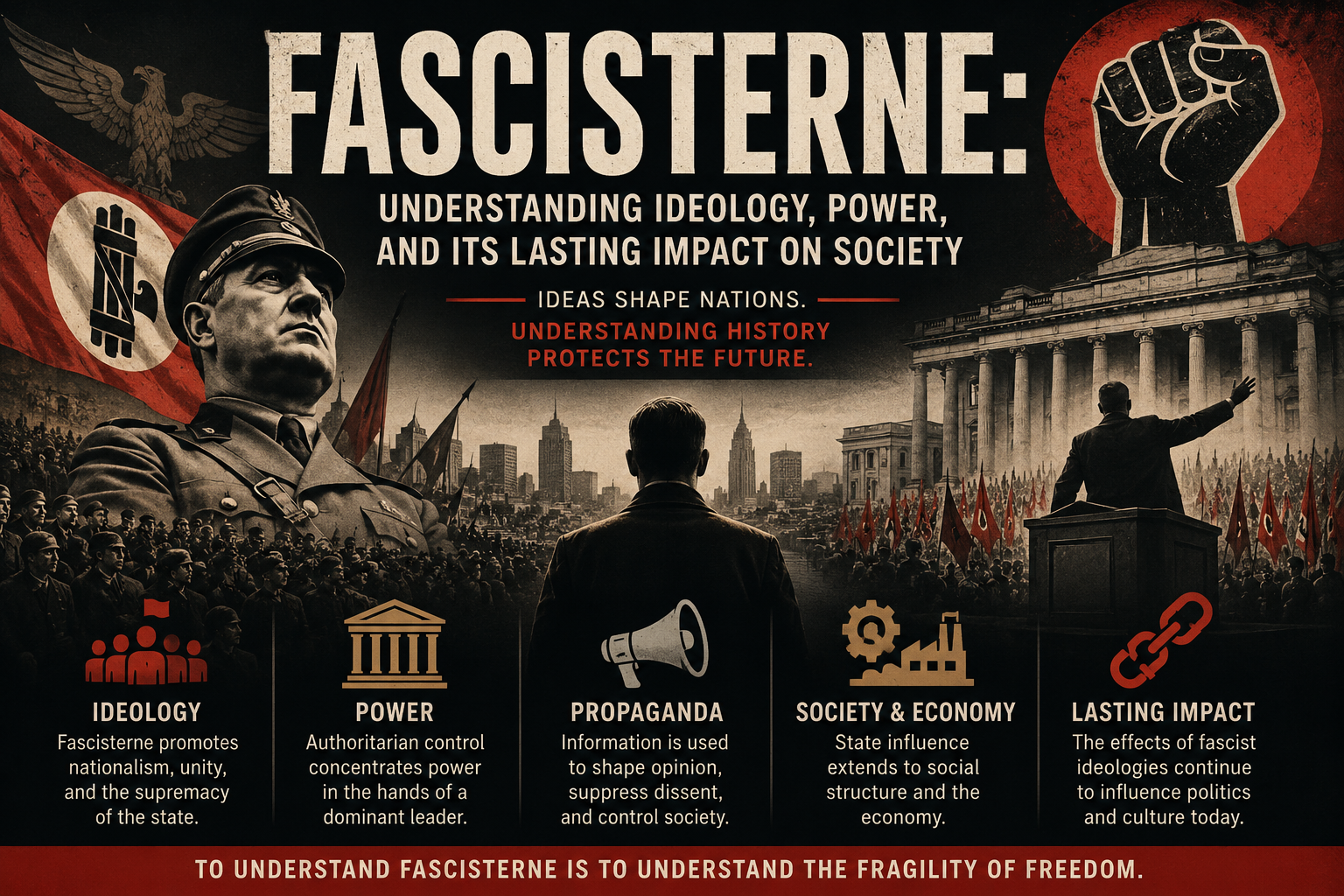
Fascisterne represents a complex and often controversial political and social phenomenon that has shaped modern history in profound ways. Emerging during a period of intense global instability, Fascisterne became associated with authoritarian governance, rigid ideological structures, and a desire to reshape society under centralized control. The term itself evokes images of power, nationalism, and strict societal organization, making it a subject of continued academic and cultural discussion.
The origins of Fascisterne can be traced to early twentieth-century Europe, where economic turmoil, political unrest, and societal fragmentation created fertile ground for radical ideologies. As nations struggled to recover from devastating conflicts and internal divisions, movements aligned with Fascisterne promised unity, strength, and a return to perceived national greatness. This promise resonated with many who felt disillusioned by democratic systems that seemed unable to address their concerns effectively.
Understanding Fascisterne requires examining not only its political implications but also its cultural, psychological, and economic dimensions. It is not merely a historical artifact but a concept that continues to influence discussions about governance, identity, and power in the modern era.
Fascisterne and Ideological Foundations
Fascisterne is deeply rooted in a set of ideological principles that emphasize authority, hierarchy, and national identity. At its core, Fascisterne prioritizes the collective over the individual, often promoting the idea that personal freedoms should be subordinate to the needs of the state. This perspective challenges liberal democratic values, which emphasize individual rights and pluralism.
The ideology of Fascisterne often incorporates elements of nationalism, where the nation is viewed as a unified entity that must be protected and strengthened. This can lead to exclusionary practices, as those who are perceived as outsiders or threats to national unity may be marginalized or suppressed. The emphasis on uniformity and cohesion is a defining characteristic of Fascisterne, shaping its policies and societal expectations.
Another key aspect of Fascisterne is its relationship with power. Authority is typically centralized, with leadership structures that prioritize control and discipline. This can manifest in various ways, including strict governance, censorship, and the suppression of dissent. The goal is to maintain stability and order, even at the expense of democratic processes.
Fascisterne in Political Structures
The influence of Fascisterne on political systems is significant, as it often leads to the establishment of authoritarian regimes. These regimes are characterized by strong leadership, limited political opposition, and a focus on maintaining control over all aspects of society. Elections, if they exist, may be tightly controlled to ensure the power.
In such systems, institutions are often aligned with the ideology of Fascisterne, creating a unified structure that reinforces the authority of the state. This alignment can extend to the judiciary, media, and educational systems, all of which may be used to promote the values and goals associated with Fascisterne.
The following table illustrates how Fascisterne influences different components of political systems:
| Political Component | Influence of Fascisterne | Outcome |
|---|---|---|
| Leadership | Centralized authority | Strong, dominant leaders |
| Media | Controlled narratives | Limited freedom of expression |
| Judiciary | Aligned with state goals | Reduced independence |
| Education | Ideological emphasis | Shaped national identity |
This structured approach ensures that the ideology remains deeply embedded within the governance framework, making it difficult for alternative perspectives to emerge.
Fascisterne and Social Dynamics
Fascisterne also has a profound impact on social structures and relationships. By promoting a unified national identity, it often seeks to eliminate differences that might challenge its vision of cohesion. This can result in the marginalization of minority groups and the suppression of cultural diversity.
Social dynamics under Fascisterne are typically characterized by strict norms and expectations. Individuals are encouraged, or compelled, to conform to these standards, which are often defined by the state. This can create a sense of order and stability, but it can also lead to a loss of individuality and personal freedom.
The role of propaganda is particularly important in shaping social dynamics. Through controlled messaging, Fascisterne can influence public perception and reinforce its ideals. This can create a shared narrative that supports the goals of the state, even if it does not reflect the full complexity of reality.
Fascisterne in Economic Systems
Economic policies under Fascisterne often reflect a blend of state control and private enterprise. While businesses may remain privately owned, they are typically subject to strict regulation and oversight. The goal is to ensure that economic activity aligns with national priorities and contributes to the overall strength of the state.
This approach can lead to a form of corporatism, where industries are organized into sectors that work closely with the government. This structure allows for coordination and efficiency but can also limit competition and innovation. Economic decisions are often guided by ideological considerations rather than market forces.
The following table provides insight into the economic characteristics associated with Fascisterne:
| Economic Feature | Description | Impact |
|---|---|---|
| State Oversight | Government regulation of industries | Controlled economic growth |
| Corporatism | Collaboration between state and business | Coordinated production |
| Labor Control | Limited worker autonomy | Reduced labor disputes |
| Resource Allocation | Directed by national goals | Strategic development |
These economic strategies are designed to support the broader objectives of Fascisterne, ensuring that all aspects of society contribute to its vision.
Fascisterne and Cultural Expression
Cultural expression under Fascisterne is often shaped by the need to promote national identity and unity. Art, literature, and media may be used as tools to reinforce ideological messages, creating a cultural environment that supports the goals of the state.
This can lead to the promotion of certain themes and styles that align with the values of Fascisterne, while other forms of expression may be discouraged or suppressed. The result is a cultural landscape that reflects the priorities of the governing ideology.
Despite these constraints, cultural expression can also serve as a form of resistance. Artists and thinkers may find subtle ways to challenge the dominant narrative, using symbolism and creativity to express alternative perspectives. This dynamic highlights the complex relationship between power and creativity within the context of Fascisterne.
Fascisterne in Modern Perspectives
In the contemporary world, Fascisterne continues to be a subject of debate and analysis. While the historical manifestations of Fascisterne are widely studied, its relevance today lies in its influence on political discourse and societal attitudes.
Modern discussions about Fascisterne often focus on the balance between security and freedom, as well as the role of nationalism in shaping policy. These debates reflect broader concerns about governance and the protection of individual rights in an increasingly complex global landscape.
The concept of Fascisterne also serves as a cautionary example, highlighting the potential consequences of concentrating power and limiting democratic processes. By examining its history and impact, societies can gain valuable insights into the importance of maintaining balance and accountability in governance.
Fascisterne and Psychological Dimensions
The appeal of Fascisterne can also be understood through psychological factors. In times of uncertainty and instability, individuals may be drawn to ideologies that promise order and clarity. Fascisterne provides a framework that simplifies complex issues, offering clear solutions and a sense of direction.
This psychological appeal is reinforced by the use of symbols, rituals, and messaging that create a sense of belonging and identity. By aligning individuals with a purpose, Fascisterne can foster strong emotional connections that support idealism.
However, this dynamic can also lead to the suppression of critical thinking, as individuals may be encouraged to prioritize conformity over independent analysis. Understanding these psychological dimensions is essential for comprehending the broader impact of Fascisterne on society.
Fascis-terne and Global Influence
The influence of Fascisterne extends beyond its original context, affecting global political and social dynamics. Its principles have been adapted and interpreted in various ways, reflecting different cultural and historical circumstances.
This global perspective highlights the adaptability of Fascisterne as an ideology, as well as its ability to resonate with diverse audiences. At the same time, it underscores the importance of understanding its मूल characteristics and potential implications.
The following table illustrates the global dimensions of Fascisterne:
| Region | Adaptation of Fascisterne | Key Characteristics |
|---|---|---|
| Europe | Historical origins | Nationalism and authoritarianism |
| Asia | Contextual variations | Cultural integration |
| Americas | Political influence | Ideological debates |
| Africa | Emerging interpretations | Socio-political adaptation |
This diversity of expression demonstrates the व्यापक impact of Fascisterne and its continued relevance in global discussions.
Fascis-terne and Ethical Considerations
The study of Fascis-terne raises important ethical questions about power, governance, and human rights. Its emphasis on control and conformity can conflict with principles of freedom and equality, leading to complex moral dilemmas.
These considerations are particularly relevant in discussions about the role of the state and the protection of individual freedoms. By examining the ethical dimensions of Fascis-terne, societies can better understand the capability of maintaining balance and accountability in governance.
Fascis-terne and Its Lasting Legacy
The legacy of Fascis-terne is multifaceted, encompassing both its historical impact and its influence on contemporary thought. While its association with authoritarian regimes has led to widespread criticism, it also serves as a valuable subject of study for understanding the dynamics of power and ideology.
By exploring the different aspects of Fascis-terne, from its origins to its modern implications, it becomes clear that it is more than a historical phenomenon. It is a concept that continues to shape discussions about society, governance, and human behavior.
In conclusion, Fascis-terne represents a complex and enduring aspect of modern history. Its influence on political structures, social dynamics, and cultural expression underscores the importance of understanding its principles and implications. Through careful analysis and critical analysis, it is possible to gain valuable insights into the nature of power and the challenges of building inclusive and equitable societies.